Have you ever heard about the sacred forest? I had only heard about it in stories when I was a child, but never actually seen one. All I knew was that in those dense woods, both ghosts and gods were said to live. It was a strange kind of forest – the kind that scared you, yet pulled you closer with curiosity. But in life, I never really saw such a jungle!
Yes, there used to be a big peepal tree near my house – it’s still there, actually. And whenever we slept on the terrace at night, its leaves would rustle against each other, making eerie sounds that scared us. It always felt like someone was sitting up there on that tree.
But imagine- what it’s like when you’re surrounded by many such trees, thick and ancient and all around you is just nature, breathing and watching. That’s exactly what I felt when I went to the Sacred Forest of Mawphlang, Meghalaya.
Why I Met Mawphlang ?
Actually, seeing the concrete jungles rise around the world made me feel that maybe the ancient societies were right — those who worked to protect their forests, whether out of fear or for power. But for them, the forest was everything… their life, their strength, their world. So, I wanted to search again for such stories — to see if such forests really exist, if there are still tribes like that. And that’s when I came across the name of the Khasi tribe . H.O. Mawrie has beautifully portrayed the Khasi tribe’s deep connection with nature by saying, “A Khasi lives with nature, and nature lives with him.” That’s why this curious soul, longing to rediscover the stories of childhood, set out to explore the Khasi’s oldest and largest sacred forest — Mawphlang.
About Mawphlang
Mawphlang, an ancient forest in a saucer-shaped depression, covers an area of about 76.8 hectares. It is located approximately 25 km from Shillong, the capital of Meghalaya. Anyone can reach here by hiring a taxi. As I arrived, after passing through an open field that stretches for some distance, a thick forest came into view. According to the tourist guides, this Khasi sacred forest is around 800 years old and has remained exactly as it was — neither expanded nor reduced, not even by an inch.”
Mawphlang Still Breathes Green — What’s Its Secret?
Mawphlang, Whose very meaning is connected to nature” (“Mawphlang” is a Khasi word, where Maw means “stone” and Phlang means “grass,” together signifying “the land of endless grassy stones.”),As I was about to explore it, the tourist guide stopped us and explained the rules — that you cannot take even a single leaf from here. If you do, Labasa, the goddess of the forest, will become angry, and as a result, you or your family may have to face negative consequences such as fever or even worse than this. This line gave me chills and sparked my curiosity at the same time — what really lies within this forest?
It’s not that the conservation of Mawphlang depends only on traditional beliefs or taboos. To protect Mawphlang, there is a unique and well-written document called “Kot Adong Hima Mawphlang,” which has been passed down from generation to generation to the headman. It contains strict rules for the preservation of this forest. For example, only residents are allowed to use forest products, and even grass cannot be sold outside the Hima. Only nearby residents are permitted to collect fuel wood from the forest, that too limited to one head load per trip per day. Otherwise, a fine of ₹10,000 has to be paid to the Hima.
Mawphlang : The Unforgettable Story
Anyway, I followed the tourist guide’s instructions and as soon as we entered the forest, there was a strange coolness, a strange silence -, only greenery and ancient trees. Even the ground was so soft as if a carpet of leaves and vegetation had been laid. As we moved further, green moss had gathered around the trees, as if this forest had not been touched for ages.
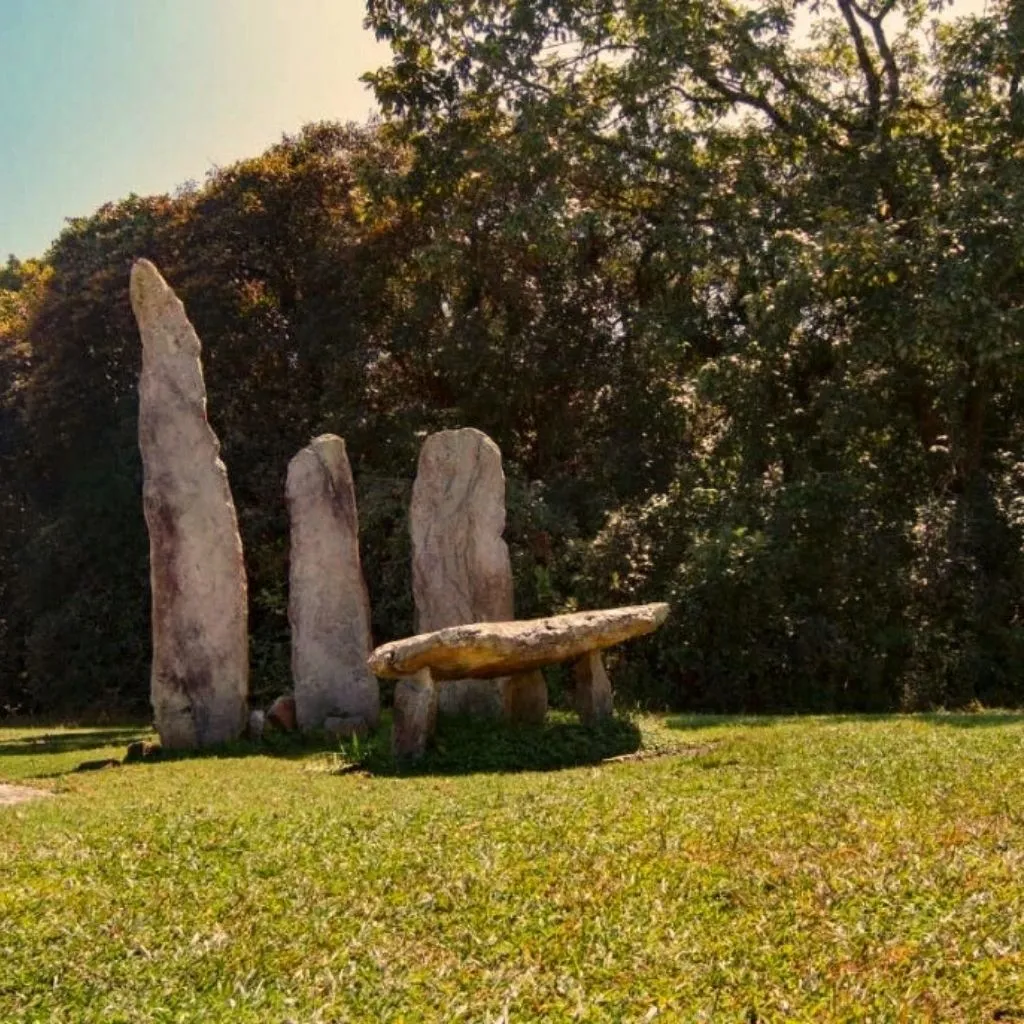
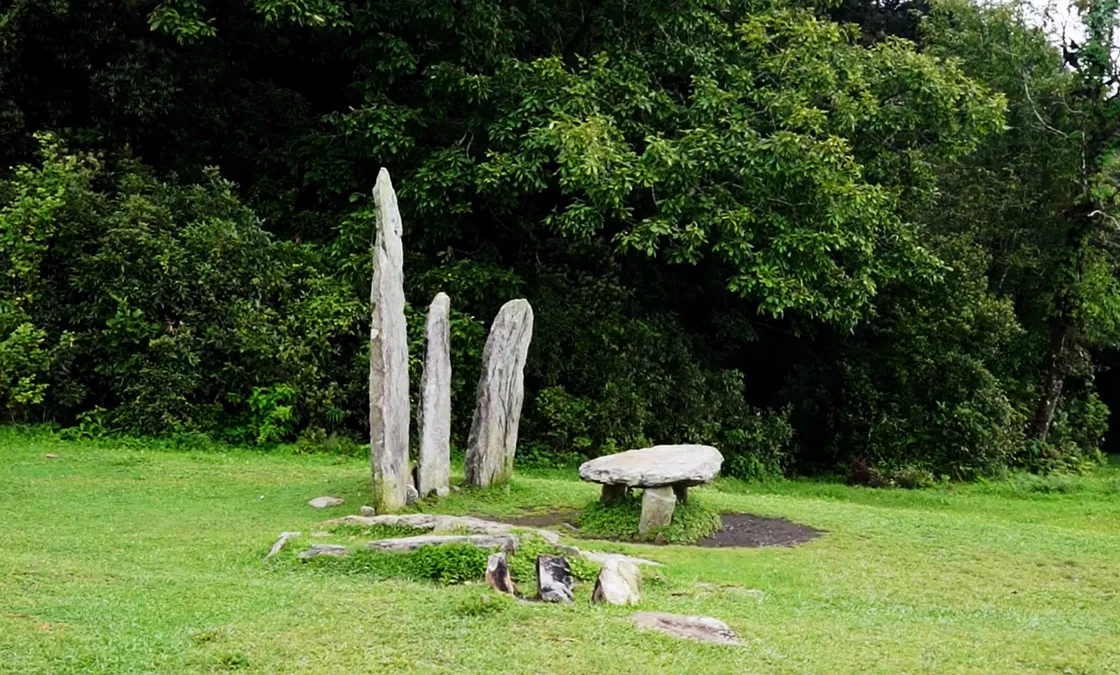
When I went ahead, the tourist guide took me along a path where old stones were embedded in the ground on both sides with a walkway in the middle. The guide said that sacrifices used to be performed on all these stones to please the goddess, and priests and people would pass through the middle. And believe me, as I walked along that path, it felt as if I was living inside one of those old stories. It was as though many unseen souls were walking beside me, and I had become part of some ancient ritual. The moment was truly thrilling. When the guide pointed out the stones where animals were once sacrificed, I looked at them intently — as if, for a moment, history might come alive again. Somehow, I moved on, trying to calm my ever-curious mind. Eventually that path led us to a large stone where sacrifices used to take place. The tourist guide said that you can pray to the goddess here for anything; she listens to everything.So I prayed, and when I looked up at the sky after praying, the sky was surrounded by those green leafy plants and they were swaying and brushing against one another, as if they were all listening.