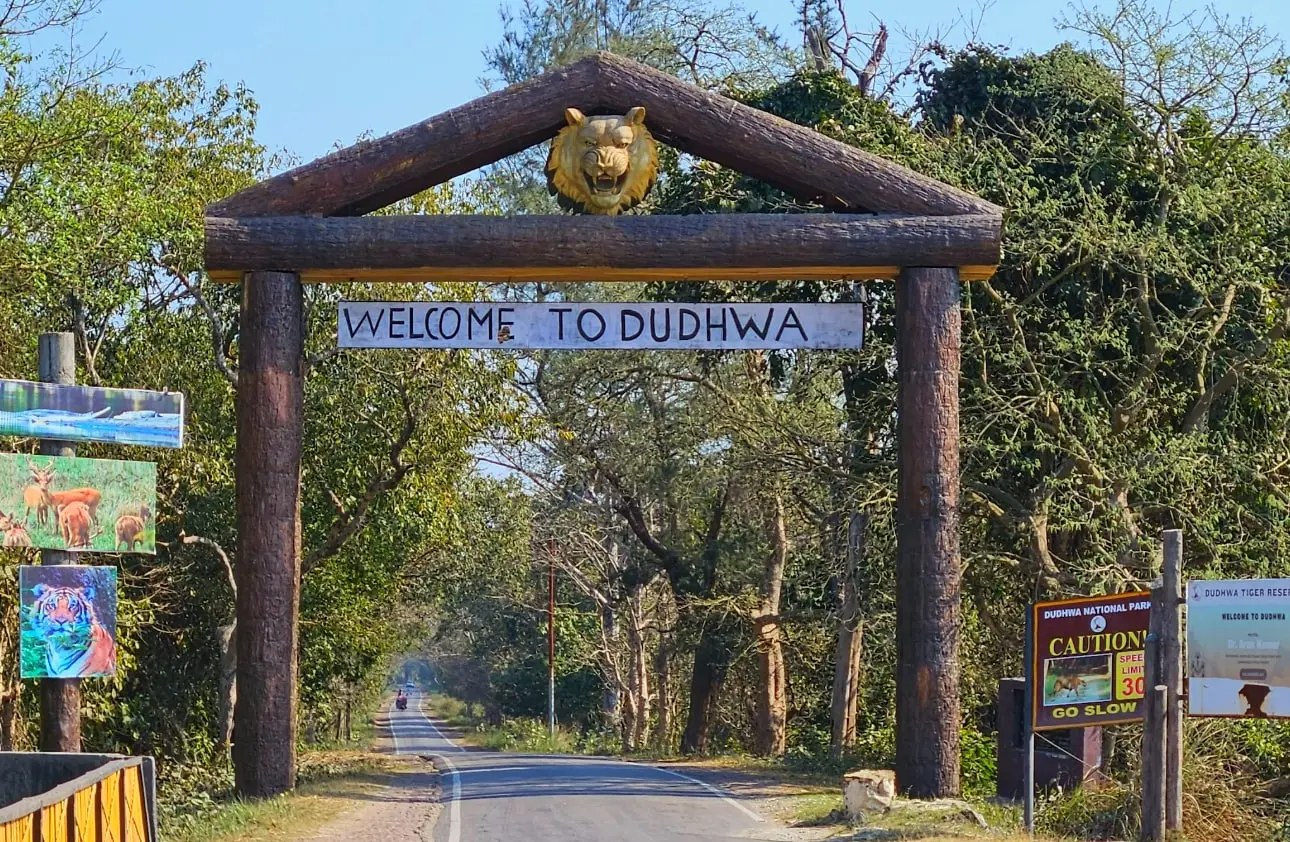
Some journeys don’t just take you into forests… they take you into yourself.
That’s exactly what happened the day I ventured into Dudhwa National Park, tucked quietly along the India–Nepal border. I had seen forests before, sure — but Dudhwa felt different from the moment I entered.
The air was thicker, older, almost sacred.
The silence was deep enough to hear your own heartbeat.
And the wilderness… well, it was alive in ways that both thrilled and humbled me.
My First Glimpse of Dudhwa — Where the Wild Still Rules
The road leading into the jungle was lined with towering sal trees, their branches knitting together like a green cathedral. Sunlight slipped through the leaves in golden stripes, and the deeper I went, the more the world outside dissolved.
This is not the kind of forest that entertains you; it tests you.
It watches you.
And when it finally decides to reveal itself, it does so with awe.
I remember rolling down the jeep window just to breathe in that earthy scent — wet soil, wild grass, and a quiet sense of mystery. Every sound felt amplified. The rustle of leaves. The distant call of a bird. The soft thud of deer hooves somewhere deep inside the green maze.
Meeting Dudhwa’s Wild Residents
If you come looking for wildlife, Dudhwa doesn’t disappoint — but you must be patient. This forest isn’t a stage show; it’s a living world with its own rhythm.
The Great Indian One-Horned Rhino
My heart nearly jumped out of my chest when I saw it — massive, prehistoric, grazing calmly near the grasslands. Dudhwa’s rhino population is one of its biggest treasures, and watching one from a respectful distance felt like witnessing a creature from another era.
The Majestic Swamp Deer (Barasingha)
Herds of barasingha stood against the tall grass like poetry — graceful, alert, golden in the sun. They’re the pride of Dudhwa, and when they move together, it feels almost like a dance choreographed by nature.
The Bengal Tiger — Silent, Powerful, Unforgettable
I didn’t expect to see a tiger, but luck had different plans. A fresh pugmark on the trail, the sudden tension in the air, the guide’s whisper… and then, there it was. A striped shadow slipping between trees. The world paused for a moment, and so did my breath.
Dudhwa isn’t just a forest — it’s an emotion.
And that tiger sighting sealed it for me.
Birdsong Everywhere
From the dazzling Bengal florican to the playful woodpeckers and hornbills, Dudhwa’s birdlife is a symphony that never stops. Even if wildlife remains hidden, the birds fill every corner with music.
The Thrill of the Safari of Dudhwa— Raw, Real, Unfiltered
The safari felt like a rollercoaster carved into the earth. Bumpy, unpredictable, but wildly exhilarating. The jeep sliced through grasslands, dipped into marshy patches, and cruised along forest corridors that looked straight out of a nature documentary.
There were moments of silence so intense, you could feel the forest breathing.
Moments where the guide raised a hand because he heard something — a call, a crack, a clue.
This wasn’t tourism.
This was surrendering yourself to the jungle and letting it show you whatever it wished.
Best Time to Visit Dudhwa — From My Own Trip Experience
I went in peak winter, and honestly, it was magical — fog curling through the trees, animals stepping out into golden meadows, and crisp air making everything feel sharper.
But here’s the full picture:
- November to April — Best season to visit
Cool weather, most animal movement, lush landscapes. - March–April — Hotter but great for wildlife sightings
Animals gather near water bodies. - Monsoon (June–October) — Park remains closed
The forest rests and rejuvenates, but travel is prohibited.
How I Reached Dudhwa — A Journey Through Rural Uttar Pradesh
I started my journey from Lucknow. The drive was long but scenic, passing through quiet villages, sugarcane fields, and wide-open skies. If you love road trips, this one has its own charm — slow, earthy, connected to the soil.
You can reach Dudhwa through:
By Air:
Nearest airport — Lucknow (230 km)
From there, hire a taxi to Lakhimpur Kheri or straight to the park.
By Train:
Nearest major station — Dudhwa / Palia Kalan / Lakhimpur
Trains from Lucknow, Delhi, and Bareilly are frequent.
By Road:
From Lucknow, Bareilly, Shahjahanpur, or Delhi — smooth highways for most of the way.
Perfect for those who love long drives packed with countryside views.
Where I Stayed — Rustic, Wild, and Peaceful
I stayed in a forest lodge near the park — nothing fancy, no luxury frills, just nature embracing you from all sides. The night was filled with sounds you never hear in cities — cricket chirps, distant animal calls, and an occasional rustle that made the darkness feel alive.
Waking up to a forest sunrise? Unforgettable.
What Dudhwa Taught Me
Dudhwa National Park reminded me that nature isn’t entertainment — it’s a living force.
It taught me patience.
It taught me humility.
It reminded me that we’re just visitors in a world far older and wiser than us.
Walking out of that forest, I felt smaller — in the best, most beautiful way.
Conclusion: Dudhwa Is Not a Place You Visit — It’s a Place That Stays With You
Dudhwa National Park is raw, untamed, and heartbreakingly beautiful. It doesn’t try to impress you. It simply exists, unapologetically wild. If you want a trip that shakes you awake, slows you down, and makes you feel deeply connected to nature, then pack your bags.
Dudhwa isn’t just a destination — it’s a memory waiting to carve itself into your heart.
